
Touch-Me-Not:
The Sharp Metallic Spell of Dormilona

The shrill beeps of my Casio alarm clock reverberating off bare high concrete walls woke me up at 5:30 am, before daylight. Looking around, I turned on a small lamp next to the bed and removed the sheet. Barefoot, I walked carefully to and then up the stairs to the kitchen of this huge concrete house on the winding road up to Planes de Renderos, a verdant plateau with expansive views above the south side of San Salvador.
A flick of a cigarette lighter and a twist of a greasy knob on an old stove lit a corona of blue and yellow flame around a pot of water. Then I took a cup and added some Nescafé to it.
I looked out the living room window to see if there was any surveillance outside again. Nah, it was too early to look. A few days ago, I poked my fat Nikon 500 mm f/8 mirror lens out the window and scared away a plainclothes policeman who was eyeing us from across the street. Every day since, I had checked to see whether he had returned or been replaced. It was cool outside, perhaps in the mid-70s, and it had rained overnight, but it was now clear. A good day for a trip to the northern department of Chalatenango.
After an instant coffee, I shaved in the bathroom under the dingy hanging light, and, after checking that the electric showerhead’s ground wire was still attached to a pipe, I took a shower with the barely heated water.
Downstairs, I dressed, grabbed my tan Domke camera bag, and returned upstairs to wake my housemate, Leon Gavriel, without disturbing his wife. Before I could knock on his bedroom door, Leon stepped out, fully clothed. He was always ready. A thin, debonair-looking man with glasses that contrasted with his black, bushy semi-handlebar mustache, giving him an academic look. “Let’s go. I have the salvoconducto,” he said, referring to the document we had received a couple of days earlier from the Estado Mayor, El Salvador’s Pentagon, which journalists needed to travel anywhere outside the capital city or the two highways that traverse the Massachusetts-sized country.
We locked the metal door behind us and climbed into my old Land Cruiser “three-on-the-floor” station wagon. I drove down the winding road toward an awakening San Salvador, and then, slowed by traffic, we made it to the Hotel Camino Real parking lot, where we were to meet our colleagues. Nobody had arrived yet, and we talked about today’s trip.
Leon wanted to interview a campesino leader in Chalatenango, whose importance was unclear to me at the time and remains so now. He was going to ask the questions, and a film crew would record the interview. I was essentially there for the ride and any possible photos of Salvadoran life. More importantly to the others, at least, I was adding a certain degree of protection for the group as a US passport holder (this was one of the reasons, as it turned out, that I had been asked to share the house with Leon’s family in Los Planes de Renderos). Leon was Austrian, the cameraman was Dutch, and the soundman and drivers were Salvadoran. And I was a Gringo, from the country that was conducting this mainly “dirty war.”
After spending some time listening to the early-morning squawking of the colorful birds in the huge trees overhanging the hotel’s expansive parking lot, a big white American 4-by-4 pulled up, driven by a Latino I didn’t know. Leon and I got in, me in the back, with my camera bag on my thighs and a gallon-sized container of water by my feet. The driver seemed nice enough and clearly knew his way around this huge American vehicle.
A tall, fit, well-built, clean-shaven man with longish blonde hair appeared at the entrance to the Camino Real, pushing up his oversized sunglasses to reveal a hint of blue eyes. When he saw we had noticed him, he waved us over. It was the Dutch cameraman Cornelis Lagrou. Clearly, Cornelis wanted Leon and me to go back into the hotel and help him with his impossibly heavy equipment. I brought my camera bag so I wouldn’t be burdened with too much of his kit. Cornelis had a huge orange over-the-shoulder Ikegami camera that he always carried – and didn’t want anyone but a competent soundman to touch. Then there was a small backpack with everything from food to filters. My camera bag trick worked, so I didn’t have to carry Cornelis’s huge, heavy wooden tripod. The tripod was rock-steady and absorbed vibrations, but it wasn’t fun to carry. I had helped carry it for miles on a trip to see an election in guerrilla-held territory in northeastern Chalatenango just a week before. On that trip, we were crossing an area of elephant grass, exhausted. You can’t see much over elephant grass, so you fix on landmarks and the sun. It felt like it was never going to end. As we crossed, a group of Army helicopters flew high above us, and we crouched down under the grass so we wouldn’t be seen. Luckily, Leo carried the heavy wooden item from the hotel. I got stuck with the blue canvas-covered heavy over-the-shoulder tape-recorder pack, which I hung over my other free shoulder. Cornelis watched me so I didn’t accidentally change any settings.
Cornelis Lagrou was based in Managua, Nicaragua, where most of the international press in Central America considered it a home away from home. Cornelis worked for the same Dutch IKON TV station that had just lost four of its journalists in a roadside ambush by an unknown actor, though we correctly assumed it was US-supported Salvadoran Army forces.
Something else on our minds was the common perception among the Salvadoran military and security forces that all fair-haired Europeans and Americans – “cheles,” we were called – were working for the guerrillas. As a result, we were considered higher-value targets by the Armed and Security forces than the Salvadorans we worked alongside, regardless of the passports we held.
By the time we got back to the car, Mapachote, a barely mustachioed, slight, but energetic Salvadoran soundman, was already there. As we got in, he started talking about his activities from the previous night, which he loudly proclaimed ended this morning with him washing off a parting gift of a “cachimabazo de mierda seca encima de su verga” from a “bien aplaudida puta.” Eyes rolled almost in unison. Boys will be boys! There he goes again, we all thought. Cornelis suggested he wear a condom next time, but this triggered Mapachote into attack mode: “The putas in El Salvador aren’t like those servicing the US military base of Palmerola,” he said, squarely looking at me. “Our putas are not infected with AIDS like those lowly ‘hang around the fort putas’ who sleep with Gringos,” he continued with a look towards me of pure disgust. “Shades of the smallpox, legendary syphilis and other diseases, an unwelcome echo of the death brought to the Americas by the European conquest half a millennium ago,” I thought to myself. And since I was the only real Gringo present, this slap had been clearly directed at me. Best to turn the other cheek and pretend not to have understood.
Silence followed as José, the ever-cautious driver, skillfully drove us around potholes and north past the San Salvador volcano and onward past the verdant foothills of the storied, guerrilla-saturated Guazapa hills to our right. He had to contend with a variety of traffic, weaving in and out, from semi-trucks to oxen-drawn wooden carts crossing the road. He drove skillfully. He knew what he was doing.
On the road, Mapachote fell silent and began checking the recorder’s settings. He really knew his way around these devices. Everyone was quite happy to put up with his raunchiness because they knew the magic he could produce. And we knew that when push came to shove, he had our backs.
We were supposed to go somewhere we all called “Santa Mierda, El Culo del Mundo.” Leon had arranged the meeting and had been told where to turn off the main road and where to wait for the person or people we were supposed to interview. The salvoconducto that gave us permission to be out of San Salvador was actually for the City of Chalatenango, farther along the road, so this was a slight diversion. Leon, Cornelis, and I had visited Chalatenango a week or more earlier, right after the now-Christian Colonel in charge of the city had painted the whole city white so that “God could view its purity from the heavens.”
As we approached the turnoff from the main road north to Honduras, toward Chalatenango, we noticed that no one at any checkpoint had stopped us. This was not too surprising. After all, this was the road north to Honduras. We slowed over some “policias muertas” (road bumps) while crossing a bridge and saw no police or army. Some olive-drab tents were visible, but no troops. Someone remarked that this was a good sign. Maybe all the “Cuilios” and “Chafarrottes” had gone home.
We turned right off the main road toward Chalatenango. We passed a military base on the left and continued down the road. Still, no checkpoint had stopped us.
Leon said, “Slow down – turn to the right,” and José obeyed. This seemed strange to me because we were south of the highway above Lake Suchitoto, and if we were meeting an insurgent peasant leader, this area wasn’t safe: it had few exit routes. Leon instructed the others to find a spot under a rare tree where Cornelis and Mapachote could set up an interview. None of the trees was particularly shady, and the hot sun was scorching. I sat in the car with the doors open, my legs dangling off the back seat. Then I noticed something interesting: we were parked on top of a Dormilona patch.
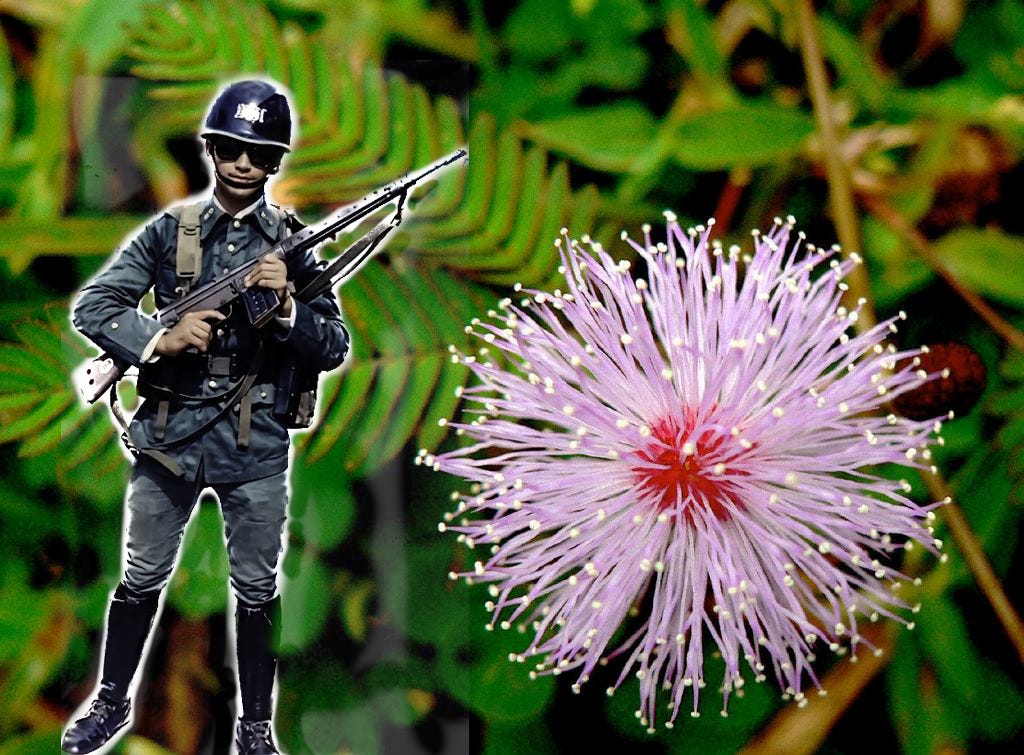
Dormilona was the name given to the low-growing, creeping, sensitive plant, or “Touch Me Not,” of the pea family, because it “goes to sleep” when touched. Its roots and leaves were rumored to have a strong, stunning, psychoactive effect. Allow me to digress. There is some history the reader might be interested in. When I first came to Central America in 1976, I was part of a scientific team interested in collecting plant and mushroom samples for herbarium and analytical purposes. We had heard about Dormilona then but had not collected any. When I returned to Central America in 1981, I collected several samples near the Usumacinta River, which divides Mexico and Guatemala. The last time I crossed the US border, I had a USDA license for certain plants. Unfortunately, my notes were disorganized, and I didn’t know which sample I brought back came from which site. But I tested them all using a very basic method called High-Performance Thin Layer Chromatography. All samples contained the usual tryptophan, serotonin, and related compounds. But some, especially those with roots, tested positive for detectable amounts of the short-acting, somewhat “psychedelic” drug 5-methoxy-DMT. This drug is also found in the “sweat” of toads and has a cult following in the US. It can produce a strong 15-minute experience similar to that of dimethyltryptamine (DMT) but without the kaleidoscopic, mandala-like eidetic imagery.
Some American indigenous populations were rumored to have used “Dormilona” for divination and shamanic purposes, and other plants containing this substance, such as the Pan-Caribbean “Cohoba” tree, also from the pea family, were far better known for such use. Unlike in Guatemala, where some Indians on the road around Lake Atitlán had looked at me knowingly while collecting the plant, few Salvadorans seemed to know about it. None present had heard of the drugs’ effects, although all knew of this diminutive, sensitive plant’s reaction to touch.
We waited and waited for the campesino leader to arrive. The others were thoroughly bored by now and quite happy to explore something different. I pulled apart some of this small plant, roots and all, rinsed it with some water, and put it on the car’s hood to dry in the sun. Perhaps this would add a little excitement to our doldrums. Another hour passed. It just got hotter. Yes, it would probably rain later, but right now we just waited in the shade of the car or under a small tree. More time passed. Were we in the wrong place? No, Leon insisted. A little after noon, he decided that we had waited long enough – we would give it half an hour more- no longer.
Seeing that the Dormilona was dry, I removed it from the car’s hood. I emptied the tobacco from a Marlboro Light cigarette, shaved off the root bark with a knife, and crushed the now-dried Dormilona leaves into a powder. Using the folded salvoconducto – the only sheet of paper we had – I poured the dried root shavings and leaves into the mouth of the empty Marlboro Light and tamped the herbal mixture with a stick. When it was full, I twisted the end to form a point. The Dormilona was ready.
We all got into the now-hot car, and I asked who was interested in trying the herb and suggested that José, the driver, shouldn’t try it. He wasn’t interested anyway. Leon, who sat next to him in the front seat, didn’t respond, but Mapachote, who sat next to me in the middle of the back seat, and Cornelis, who sat to his right, were interested. What the hell, we had wasted half a day out here in Santa Mierda, El Culo del Mundo!
I explained that probably nothing would happen, but if it did, it could be strong. Even if it was strong, it would only last fifteen minutes… “Don’t worry,” I told them. “I would try it first…”
José pulled out onto the road. We were all happy we would finally be able to cool off in the breeze.
I took out a Bic lighter, lit the conical end, and inhaled… It didn’t blow out, perhaps because of the wind from the open windows. After a few more clicks, it lit, and the end of the spliff caught fire. I inhaled deeply, then again, and was about to cough, but I passed it to Mapachote. A sudden pressure in my head and a general sense of hyper-aliveness indicated something was happening. I felt like I was being transported into another world – and I was – a far scarier one. Mapachote coughed after inhaling and passed it to Cornelis on his right. I felt stunned, and time slowed. The little three-inch-high green Dormilona plant had me,
BUT there was a bridge ahead that had been unguarded when we passed through this morning, and now it came into sharp focus. From a distance, I could see it bristling with a handful of men wearing helmets and uniforms straight out of the 1930s, knee-high black leather jackboots, jodhpurs, and shiny G3 rifles, two of which were pointed in our direction. These were the feared Policia de Hacienda, which generally had a far worse reputation than the Army. Or at least they looked that way. The policeman in front showed us his palm in an unmistakable order to stop. I wanted to make sure the spliff was gone, but there was no time to ask. José slowed us to a stop on the bridge beside them. We were surrounded. One of the policemen ordered José to pull over just beyond the bridge and get out of the car. Another policeman chuckled over a radio, “We’ve caught five DTs (terrorist delinquents) - three ‘cheles’ and two ‘piricuacos’” (another word for insurgent used by the right wing, especially the death squads). Oh shit, we are going to get shot, just like Cornelis’ colleagues had been, I thought. Terror was on all our faces as we got out of the car. Here we were: three enemy Cheles and two Salvadorans in a car these police could only dream of traveling in. You could see the envy of the new, clean car on their faces. You could also feel the hostility toward us, who had the freedom to travel in it.
The policemen were perspiring in their heavy uniforms and sweat dripped from the rims of plastic helmet liners, painted to look like the real thing. They were always sweating, it seemed. Under the spell of the Dormilona, their faces looked metallic and machine-like. I looked at Mapachote’s eyes, and they were dilated. Perhaps mine were… a dead giveaway, I thought, paranoically. But then so were the driver’s. And I knew for sure he hadn’t smoked any. He was just scared.
Before they could ask for our IDs, Leon whipped out the sweaty, six-folded Dormilona-stained salvoconducto from his shirt pocket and handed it to the nearest policeman. He opened it but couldn’t read it, so he passed it to another. Since my surname was first in the alphabet, the policeman who could read wanted my ID first. I nervously looked for it in my wallet, but José pointed out that it was clipped to my photographer’s vest. Duh! Everyone but the driver had a government-issued COPREFA Press card. He was listed on the salvoconducto, but that wasn’t enough for the Hacienda Police. He knew how to play the vertical power game. He claimed to know the head of the Policia de Hacienda. The other policemen weren’t buying it. Would they hold him and let us go? How would we explain that to his family?
While we were showing our IDs to the policemen, other policemen were searching the car when the arrival of a semi-truck interrupted them, and they waved it through. Next, an American school bus converted into an intercity bus followed. The Policia de Hacienda were supposed to stop these, but they let them pass. But I now felt some relief – we had been seen.
Another bus came from the south, and the policeman waved us back into the car and turned to it. Dormilona’s spell was over, and I was “coming down.”
Inside the car, the flattened spliff sat on the floor, right where Cornelis had stepped on it. Evidently, the policeman looking in the car had missed it or been unconcerned about it – but if he had been, that could have been a disaster.
We returned to the hotel in thoughtful silence. It hadn’t been nearly as bad as it had felt. But I had learned my lesson; danger lurked around every corner in El Salvador amid a civil war. I never took another psychedelic drug during my six years in this country, and I didn’t even indulge in the Cannabis that so many of my peers smoked in the evenings. But sometimes during the rainy season, I collected the “cow patty mushrooms,” known as Psilocybe cubensis, for those who were less cautious. That is another story.
Epilogue
Among those traveling with me that day, Cornelis was the best known. Two years later, he was shot by the Army in combat – while filming. Joni Chevez, another excellent Salvadoran driver in a different car, did her best to drive his bleeding body to a hospital, but an Army helicopter kept machine-gunning the road in front of her, slowing her progress and ensuring that Cornelis would bleed out. He would be the fifth Dutch journalist killed in El Salvador.
I would like to thank the writer Gabe K-S for inspiring me to pen this story. Also, other than an ayahuasca trip in a Shipibo Indian hamlet during a multi-day walk between MRTA guerrilla camps in the Amazon in 1992, this was my last experience with anything like an entheogen. But I am sure there will be others in the future, near or far.
